Posts

Lenin and the Bomb

Image
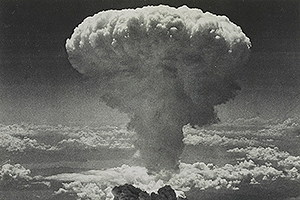
A historical materialist cannot do without the notion of a present which is not a transition, but in which time stands still and has come to a stop. For this notion defines the present in which he himself is writing history. Historicism gives the ‘eternal’ image of the past; historical materialism supplies a unique experience with the past. The historical materialist leaves it to others to be drained by the whore called ‘Once upon a time’ in historicism’s bordello. He remains in control of his powers, man enough to blast open the continuum of history. -Walter Benjamin,  On the Concept of History A couple of months ago my reevaluation of Lenin's contemporary role began with an impassioned rejection of his centrality in the "revolutionary socialist" movement. While most of the Left had already written off Lenin, he surreptitiously retained a hegemony on both the hopes of self stylized revolutionary socialists and over their unequivocal failures ever since, say, the wint...

Study Abroad

“I’ve never killed anyone.” She thought back to the “Path to Personhood” poster she had seen to reply “Wrong, you kill people all the time. They’re just not really people yet. Your body is constantly killing thousands of people daily and you eat plants, don’t you?” Keegan, grateful for any sort of digression stopped a moment before responding, “I hardly think the inhabitants of my gut can be considered human.” “Well, none of them are ever going to be considered human if you don’t hurry it up.” “Why don’t you do it? You clearly want to eat this guy more than I do.” “I already brought him here and set this all up, didn’t I? And anyways I’ve already shown that you’ve killed someone before. I have never eaten which is why you need to stop chattering.” “You’re the one chattering. I thought normal tourists in Thailand came to do sex crimes, not this. This poor boy has enough problems here I’m sure.” The two girls had been standing over the never unconscious body. Th...

Excerpt from "On the Concept of History"

"The consciousness of exploding the continuum of history is peculiar to the revolutionary classes in the moment of their action. The Great Revolution introduced a new calendar. The day on which the calendar started functioned as a historical time-lapse camera. And it is fundamentally the same day which, in the shape of holidays and memorials, always returns. The calendar does not therefore count time like clocks. They are monuments of a historical awareness, of which there has not seemed to be the slightest trace for a hundred years. Yet in the July Revolution an incident took place which did justice to this consciousness. During the evening of the first skirmishes, it turned out that the clock-towers were shot at independently and simultaneously in several places in Paris. An eyewitness who may have owed his inspiration to the rhyme wrote at that moment: Qui le croirait! on dit,  qu'irrités contre l'heure  De nouveaux Josués  au pied de chaque tour,  Tiraien...

Three Photos Inside Oakland, California

Image
Two Cities, Separate and Unequal Two Cities, Separate and Unequal is a takeoff from an infamous line in the Kerner Report (1968): “Our nation is moving toward two societies, one black, one white - separate and unequal” (p.1). Oakland is a diverse city as measured by almost any standard. However, the city is not exempt from capitalism’s tendency to concentrate wealth in the hands of a small minority while increasing the immiseration of the masses. A life of luxury and leisure can be found in Oakland (as represented by the woman in sunglasses), but only for a (mostly white) minority. The play areas of the rich and famous, as well as the main hubs of capital, are protected through various forms of architecture, policing, and the overall structure of the market (as represented by the bars). Today, Oakland has become synonymous with gentrification, the technology industry, and unaffordable housing. Justice for Philando Castile Justice for Philando Castile contains many mess...

A Dance

The boy hardly looked like he had handled civilian corpses just weeks earlier, if it weren’t for the side caps and the hall’s decorations no one would know. The war was over now and the 20 year olds had not aged at all but had ended an age. “I am going to dance tonight,” said the one with the white shoes. The voices of the black and brown shoed boys around him blended into a patchy incongruence that resembled their suits as they yelled across to each other. Once, the dance routines were nearly synchronized, the grand waltzes founded by the clockwork switching of partners. Today the band was playing faster and the partners were switching with less fidelity as the excitement of a different kind of abandonment seized the young people and their drab dress shoes were submerged into the wood floor. Above the floor and above the frenzy was a long way that the banners reached before originating from the ceiling. The old banners with their fathers’ stern faces had b...